Plant and Animal Cell Diagrams
Labeled diagrams of both cells plus label-it worksheets with a word bank · 4-page PDF · Grades 5–8
📄 Download PDF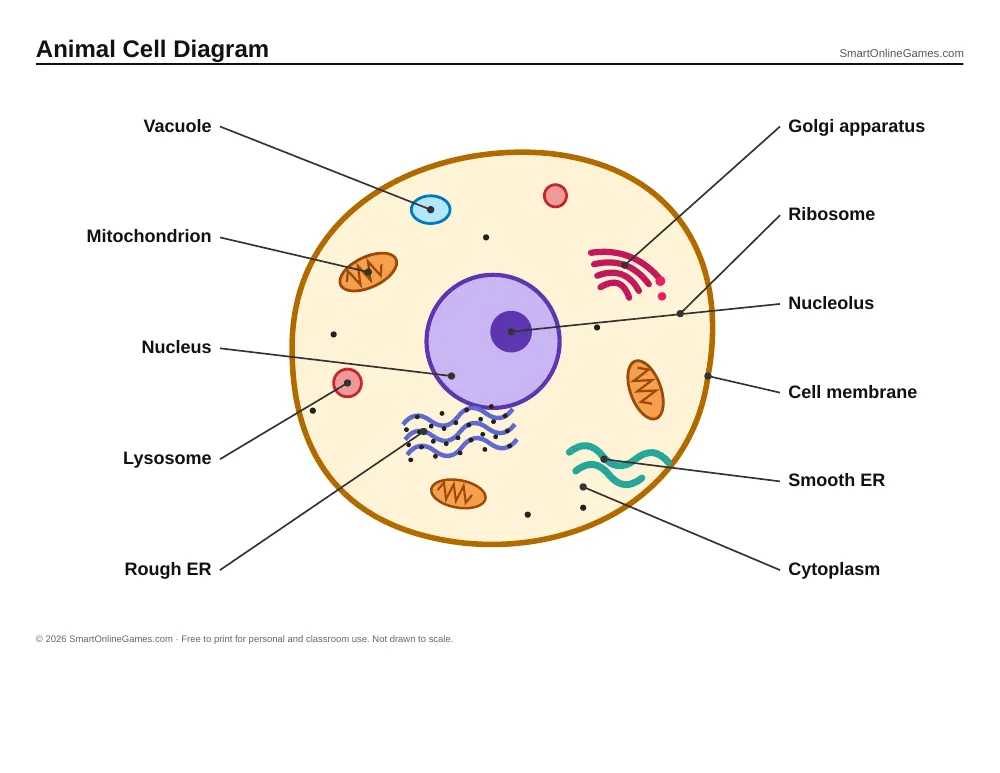
What's in the PDF
Four landscape pages. Page 1 is a labeled animal cell and page 2 a labeled plant cell, each with 11 parts. Pages 3 and 4 are the same drawings with empty label boxes, a name and date line, and a word bank listing the 11 parts in alphabetical order. Because the boxes sit exactly where the labels do on pages 1 and 2, those two pages work as the answer key.
The parts and what they do
| Part | Labeled on | What it does |
|---|---|---|
| Cell membrane | Both | A thin, flexible layer around the cell that controls what goes in and out. |
| Nucleus | Both | Holds the cell's DNA, the instructions for making proteins and running the cell. |
| Nucleolus | Both | A dense spot inside the nucleus where the parts of ribosomes are made. |
| Cytoplasm | Both | The jelly-like material that fills the cell and holds the organelles. |
| Mitochondrion | Both | Releases energy from food for the cell to use. (Plural: mitochondria.) |
| Ribosome | Both | A tiny structure that builds proteins. Many sit on the rough ER; others float free. |
| Rough ER | Both | A folded membrane studded with ribosomes, where many proteins are made and moved. |
| Golgi apparatus | Both | Sorts, packages and ships proteins and other materials, like a cell post office. |
| Smooth ER | Animal sheet | Membrane tubes without ribosomes that make lipids (fats). Plant cells have it too; it is labeled on the animal sheet only. |
| Lysosome | Animal | A small sac of digestive enzymes that breaks down worn-out parts and waste. |
| Vacuole | Both (large in plants) | Stores water and other materials. Plant cells have one large central vacuole. |
| Cell wall | Plant | A stiff outer layer, made mostly of cellulose, that supports and protects the plant cell. |
| Chloroplast | Plant | Captures energy from sunlight to make food through photosynthesis. |
How to use the sheets
Model first, then label. Project page 1 or 2 and talk through each part with its job: the nucleus holds the instructions, the mitochondria release energy, the membrane controls what goes in and out. Then hand out page 3 or 4 and let students label from memory before they use the word bank. Labeling the plant cell after the animal cell lets students spot the three extra parts on their own: the cell wall, the chloroplasts and the large central vacuole.
Make it a comparison. Have students draw a Venn diagram with the 11 parts from each sheet. Eight parts go in the middle on these sheets. Then ask why a plant needs chloroplasts and a cell wall when an animal doesn't: plants make their own food from sunlight and cannot move to find support.
Common mix-ups
"The cell wall and the cell membrane are the same thing." Plant cells have both: the stiff wall on the outside and the flexible membrane just inside it. Animal cells have only the membrane. "Animal cells don't have vacuoles." Many do, but they are small; plant cells usually have one large central vacuole. "Plants have chloroplasts instead of mitochondria." Plant cells have both. Chloroplasts capture energy from sunlight to make food, and mitochondria release energy from that food.
Questions
Is there an answer key for the blank worksheets?
Yes. Pages 1 and 2 are the answer key: they show the same drawings with every label in place, in the same positions as the blank boxes on pages 3 and 4.
Why does the animal cell have a vacuole?
Animal cells can have small vacuoles that store water and other materials. Plant cells usually have one large central vacuole that fills much of the cell and helps keep it firm.
Are the diagrams drawn to scale?
No. Real organelles differ enormously in size, and ribosomes are far too small to see this way, so the drawings make each part big enough to label. Teach them as models, not photographs.
Which parts are only in plant cells?
Of the parts on these sheets, the cell wall, chloroplasts and the large central vacuole are found in plant cells but not animal cells. Lysosomes are drawn only in the animal cell, following the usual middle-school textbook comparison.
Try the interactive plant and animal cell explorer to tap each part and read about it.
Standard: NGSS MS-LS1-2, develop and use a model to describe the function of a cell as a whole and ways the parts of cells contribute to the function.
Sources: OpenStax Concepts of Biology (via Lumen Learning): Animal Cells versus Plant Cells · NHGRI Talking Glossary: Cell · Mitochondria · Golgi body · Lysosome · Ribosome · Nucleolus · NGSS MS-LS1-2
Last reviewed: November 2026